
Resistance Training for Body Recomposition: A Strength-First Guide for Women

If you've ever trained hard for months and watched the scale refuse to budge, or "lost weight" and ended up feeling weaker and more tired, you've been measuring the wrong thing.
What most women actually want isn't a smaller number. It's to feel strong, look defined, have energy, and keep that body for decades. There's a name for that goal: body recomposition. And the most powerful tool for getting there is resistance training.
In this guide, we'll cover what body recomposition is, whether it really works, how long it takes, how much protein you need, and how we use InBody body composition scans at The Fit In to track real progress, not just weight.
What is body recomposition?
Body recomposition means building lean muscle and reducing body fat at the same time, often with little or no change on the scale. A 2024 editorial in Frontiers in Nutrition defines it as "reducing body fat while maintaining or increasing lean mass, frequently with no changes in total body mass."
The traditional fitness narrative splits goals into two phases: "bulking" to gain muscle, then "cutting" to lose fat. Recomposition skips that cycle. You give your body a reason to build muscle (resistance training) and the materials to do it (protein), and your body composition shifts in your favor.
Does body recomposition really work?
Yes. Research reviews have found recomposition happens across very different groups: sedentary beginners, older adults, and even people who already lift regularly. A 2020 review in the Strength and Conditioning Journal asked whether experienced lifters can build muscle and lose fat at the same time, and concluded that they can, given progressive resistance training and adequate protein.
It does work best for some people:
Beginners, or anyone returning to strength training after time off
Women over 40, who are often starting from lower muscle mass
Anyone carrying more body fat than they'd like
Women on GLP-1 medications, where preserving muscle while losing weight is the whole game
Why muscle matters so much, especially after 40
Muscle is more than "tone." It's active tissue that supports your metabolism, your blood sugar, your balance, your bones and your independence as you age.
Muscle does burn more energy at rest than fat. Each kilogram of muscle burns roughly 13 calories a day at rest. That's modest on its own, so the bigger win is everything else muscle does for you. Women naturally lose muscle as they age, and the drop in estrogen during perimenopause and menopause speeds that up. That's why resistance training moves from "nice to have" to non-negotiable in your 40s and beyond.
It also protects your bones. Read how one Fit In member stopped her bone loss and then increased her bone density with progressive strength training in Improving Muscular Strength and Endurance Slows Bone Density Loss.
How resistance training drives recomposition
Resistance training is any exercise where your muscles work against a load: dumbbells, kettlebells, resistance bands, your own body weight, or the springs on a Pilates reformer. Here's what it does:
Signals your body to keep and build muscle. When you eat a little less, your body may break down muscle for energy. Strength training tells your body that muscle is essential, so more of what you lose comes from fat.
Changes your shape, not just your size. Muscle is denser than fat, which is why two women who both weigh 150 pounds can look completely different. The one with more lean muscle looks stronger and more defined.
Builds strength you use every day. Carrying groceries, climbing subway stairs, getting up off the floor. Functional strength is the benefit you feel first.
How to do body recomposition (for women)
Four pillars. Get these right and the rest is detail.
1. Strength train 2–4 times a week, and progress
Hit your whole body: squat, hinge (deadlift patterns), push, pull and carry. The key ingredient is progressive overload: gradually adding weight, reps or difficulty over time. If your workouts feel the same in month three as in week one, your body has no reason to change.
2. Eat enough protein
This is the pillar most women miss. A major meta-analysis of 49 trials, published in the British Journal of Sports Medicine, found that gains in lean mass from resistance training kept improving with protein intake up to about 1.6 grams per kilogram of body weight per day (about 0.7 grams per pound), then leveled off.
Body weightDaily protein target:
130 lb → ~95 g protein a day
150 lb → ~110 g
170 lb → ~125 g
190 lb → ~140 g
210 lb → ~150 g
Spread it across your meals, around 25–40 grams each. If you have kidney disease or another medical condition, check with your doctor or a registered dietitian first.
3. Don't starve yourself
A small calorie deficit supports fat loss. A big one costs you muscle. Research on recomposition favors a high-protein diet with moderate, gradual reductions over aggressive dieting. Fuel your training.
4. Sleep and recover
Muscle is built between workouts, not during them. Seven or more hours of sleep and at least one full rest day a week make your training count.
How long does body recomposition take?
Most research programs run 8 to 12 weeks and show measurable changes in lean mass and body fat in that window. In real life, plan on:
Weeks 1–4: You get stronger fast. This is mostly your nervous system learning the movements. Your clothes may start fitting differently.
Weeks 8–12: Measurable change on an InBody scan: more lean mass, less body fat.
Months 3–6 and beyond: The changes you and other people notice. Recomposition compounds over time, so consistency beats intensity.
The scale may barely move through all of this. That's the point.
Why the scale lies (and what to track instead)
If recomposition is working, your weight might stay exactly the same, or even go up. You could lose two pounds of fat and gain two pounds of muscle. The scale says "zero progress." Your body says otherwise.
This is where most people quit, just before it starts paying off. That's why we move beyond the scale with the InBody body composition analyzer. (More on this in InBody vs. the Scale.)
What InBody tracks:
Skeletal muscle mass: exactly how much muscle you're building
Body fat percentage: how much of your weight is fat versus lean tissue
Segmental lean analysis: muscle balance between your right and left sides, and your upper and lower body
Basal metabolic rate (BMR): your estimated calorie burn at rest
Scan every 4 to 8 weeks and you'll stop guessing. You'll see fat mass drop and muscle rise, and that's the motivation that keeps you going.
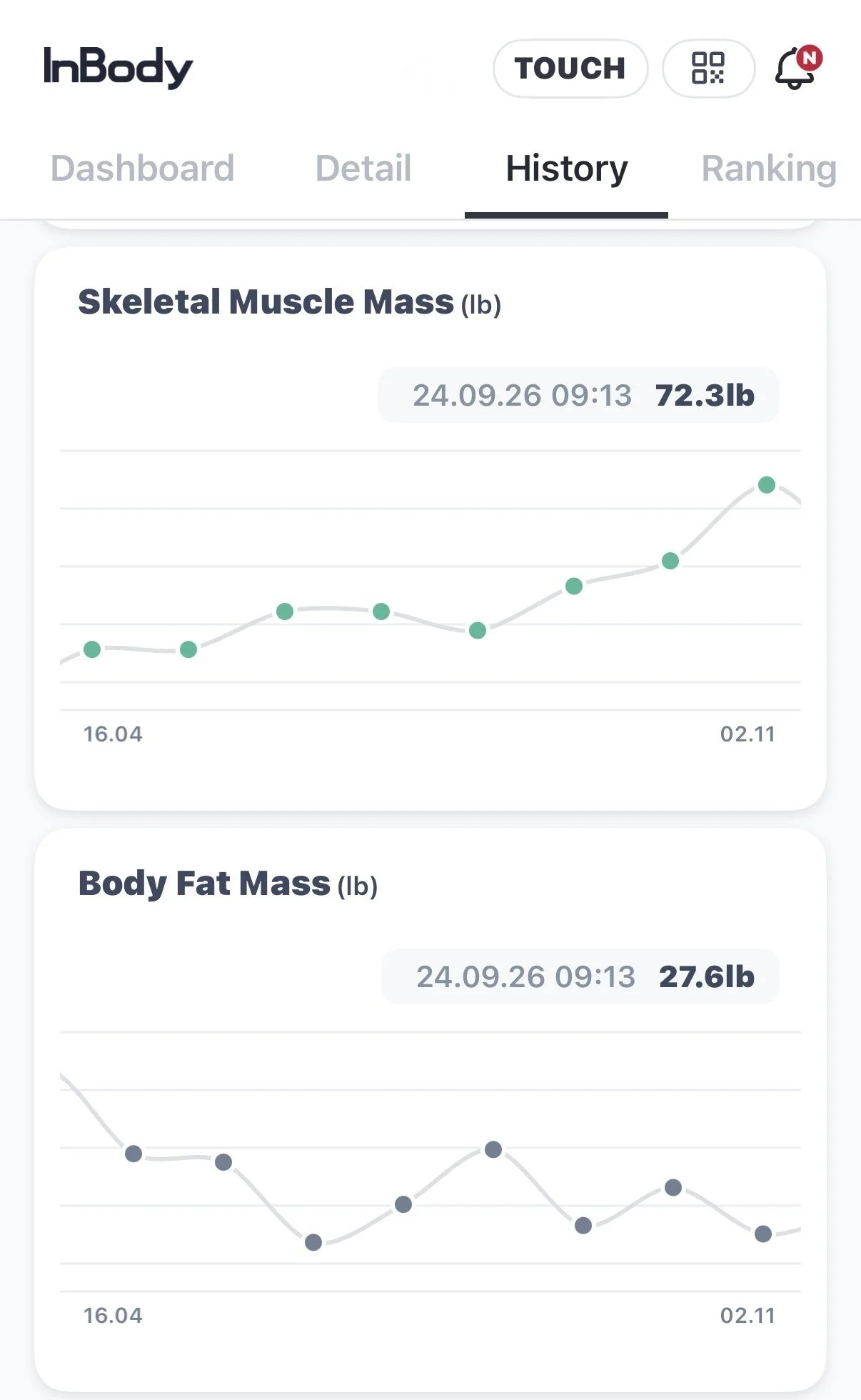
This The Fit In client’s strength training routine shows their increase in muscle mass and decrease in fat mass over the same period.
A sample recomposition week at The Fit In
Day 1: Strong or Lift & Length
Day 2: Pilates Reformed: Strong or Pilates Mat: Strong
Day 3: Walk and rest
Day 4: Stronger, Strong or Lift & Length
Day 5: Pilates Mat: Strong
Day 6: Stretch & Release, plus a long walk
Day 7: Full rest
Check the schedule for current class times.
New to strength training? Start with 2 strength days and build from there. We recommend at least five Strong: Fundamentals classes before joining Pilates Mat: Strong.
Body recomposition in perimenopause and menopause
Falling estrogen makes it easier to lose muscle and gain fat around your middle, even if nothing else has changed. Recomposition is still possible. It just asks you to be more deliberate:
Lift heavier than you think you should. Light weights for lots of reps won't give your muscles and bones enough reason to adapt. Work up to loads that feel challenging by your last few reps.
Hit your protein number every day, not just on training days.
Measure body composition, not weight. Menopause can shift the scale for reasons that have nothing to do with your effort.
Our founder, Ife, went through early menopause at 36. She shares what she wishes she'd known in My Journey With Early Menopause and Things You Should Know.
FAQ
Can women build muscle and lose fat at the same time? Yes. Body recomposition is well documented in research, especially in beginners, women returning to training, and older adults. The combination that works is progressive resistance training plus enough protein.
How long does body recomposition take for women? Expect to feel stronger within a few weeks, see measurable changes on a body composition scan in 8–12 weeks, and see visible change over 3–6 months of consistent training.
How much protein do I need for body recomposition? Research suggests about 1.6 grams per kilogram of body weight per day (about 0.7 grams per pound) to maximize muscle gains from strength training. For a 150-pound woman, that's about 110 grams a day.
Is Pilates enough for body recomposition? Reformer and barre classes build real strength and endurance, and they're a great part of the mix. For the best results, pair them with 2–3 sessions a week of progressively heavier resistance training.
Should I track my weight during body recomposition? Weight alone can be misleading, because you may gain muscle while losing fat. A body composition scan like InBody shows what's actually changing.
Start your recomposition at The Fit In
Consistency is the most important factor in body recomposition, and it's a lot easier when you're part of a community that notices your first unassisted pull-up or your new deadlift PR. We're not a big-box gym where you're just a number. We're neighbors getting stronger together in Bed-Stuy, Crown Heights and East New York.
Your recomposition checklist:
Book your InBody scan to get your baseline.
Commit to 2–3 strength sessions a week. See strength classes →
Hit your protein target using the table above.
Rescan in 8 weeks and let the data tell the story.
Want a plan built around your body and goals? Book a private training session →
This article is for educational purposes and isn't medical advice. Talk to your doctor before starting a new exercise or nutrition program, especially if you have a medical condition or take medications like GLP-1s.
Sources
Bonilla DA, et al. Editorial: New insights and advances in body recomposition. Frontiers in Nutrition, 2024. PMC
Morton RW, et al. A systematic review, meta-analysis and meta-regression of the effect of protein supplementation on resistance training-induced gains in muscle mass and strength in healthy adults. British Journal of Sports Medicine, 2018. PubMed
Barakat C, et al. Body Recomposition: Can Trained Individuals Build Muscle and Lose Fat at the Same Time? Strength and Conditioning Journal, 2020. Journal