
Improving muscular strength and endurance slows bone density loss
We don't usually think about everything our bones do for us. They protect our organs, hold us upright, and store minerals like calcium and phosphorus that our bodies draw on when we need them most. Most of us don't give them a second thought until a doctor hands us a bone density report.
For Vicki, a longtime Fit In member, that moment came with an osteopenia diagnosis. Osteopenia means your bones have lost mass and become weaker than they should be. People with osteopenia are at higher risk of developing osteoporosis, where bones become fragile enough to break from a minor fall.
Vicki's story shows exactly what we want every woman over 40 to know: the right strength training can stop bone loss, and in many cases reverse it.
Bone density starts declining in your mid-30s
Your bones are living tissue. Old bone is broken down and new bone is built all the time. Around age 35, the breakdown starts to outpace the rebuilding. Even very healthy people lose bone density gradually, usually less than 1% a year.
Women are at higher risk of osteopenia and osteoporosis. Having a small frame, smoking, heavy drinking, getting too little calcium, or a history of anorexia raises that risk further.
Why menopause speeds everything up
Estrogen helps protect bone. When estrogen drops during menopause, bone loss speeds up sharply. According to the Bone Health & Osteoporosis Foundation, a woman can lose up to 20% of her bone density in the five to seven years after menopause, and about one in two women over 50 will break a bone because of osteoporosis.
That's why perimenopause and your first years after menopause are such an important window. What you do for your bones now shapes how strong you are at 70 and 80. For the full picture, read our complete guide to strength training for menopause.
Vicki's story
Vicki's doctor told her that her slight frame was a risk factor for osteoporosis. When her baseline bone density exam showed osteopenia, her doctor prescribed calcium and vitamin D supplements and a prescription medication.
"My doctor also said it would be really great if I did some weight-bearing exercises," she recalls. "I was not, at that time, doing any exercising. I would walk – commuting to the city every day, so I was walking, going up and down the subway stairs. So I was on my feet a lot, but I was not doing any kind of structured exercise."
Despite that recommendation, it took Vicki two years to find a workout routine that worked for her.
"There was nothing in our neighborhood at that time that I felt comfortable going to. But when I saw The Fit In, it was so close to my house and it has such an incredible community," Vicki says.
Soon after joining, Vicki went from weekend workouts to a mix of Pilates and Strong classes four to five days a week, and she soon learned her routine was helping to counter the effects of age on her bones.
"Between the second exam and third, I had maybe started working out at The Fit In for six or seven months. The first bone density test showed a decline in my bone density but the third one showed that I had stabilized and wasn't going down," she says.
Buoyed by those results, Vicki increased her workout frequency and asked Ife, The Fit In's founder, about private sessions focused on strengthening her bones.
"We did an assessment session. Even though she'd been seeing me in her classes for almost two years, it was an opportunity to sit down and find out what was motivating this desire for one-on-one work," she says. "I said I wanted to increase my bone density. If osteoporosis isn't treated, when you get older, if you fall, you will have a broken bone, and it really impacts your overall. So I was like, I do not want that."
With bone density as the goal, Ife designed a private training program in six-week cycles built around weight-bearing exercises, cardiovascular conditioning, and core strengthening. In every session, Ife tracks the weight and reps Vicki completes for each movement, with the goal of increasing both from week to week.
Since starting the program, Vicki feels stronger and has less pain in her shoulder and neck. Her posture has improved as her core has strengthened. And her bone density has improved.
"I just got another bone density test and the density of the bone in my spine has increased at a statistically significant rate and my hip bone density has also increased," she says.
Those gains matter to Vicki, who has watched friends break bones, likely because of low bone density. "I have a friend who I grew up with in Australia, and she has a similar build to mine. She's a little younger than I am, but she's already had a bone fracture," Vicki says. "I told her she needs to get a bone density scan and work on it because, at some point, it gets harder and harder to achieve increased bone density as you get older."
She adds: "I'm really glad I started doing this now. Before I get into my 60s, when it will be more difficult. If I continue to build on this I could really change the trajectory of my health for the next few decades."
Strength training lessens bone loss. Here's the research.
Vicki's results aren't a fluke. Bone responds to load: when muscles pull on bone and your body works against gravity, bone gets the signal to rebuild.
The best-known study on this is the LIFTMOR trial, published in the Journal of Bone and Mineral Research. Researchers followed 101 postmenopausal women with low bone mass (osteopenia or osteoporosis) for eight months:
One group did supervised, high-intensity strength and impact training: two 30-minute sessions a week, working up to 5 sets of 5 reps at heavy loads.
The other group did a gentle, low-intensity home program.
The results:
Spine: the strength group gained about 2.9% in bone density. The gentle group lost about 1.2%.
Hip (femoral neck): the strength group held steady (+0.3%). The gentle group lost about 1.9%.
Safety: just one minor adverse event (a back spasm) across the strength group, under close supervision.
Two takeaways. First, intensity matters: light weights and gentle movement didn't protect bone the way progressively heavier training did. Second, supervision matters: these women lifted heavy safely because they were coached, with the load increased gradually. That's the same approach Ife used with Vicki.
What counts as bone-building exercise?
Weight-bearing and resistance exercise builds muscle and bone strength, improves balance, and can relieve pain. That includes:
Strength training with dumbbells, kettlebells, barbells or resistance bands
Impact work like stepping, hopping or jumping, if it's appropriate for you
Dancing, brisk walking, running, and stair climbing
Tai chi, for balance and fall prevention
A note on Pilates and yoga: both build strength, balance and posture, which all protect you from falls. But if you have osteopenia or osteoporosis, some movements, especially deep forward bends and loaded spinal flexion like roll-ups, can increase fracture risk. Tell your instructor about your diagnosis so they can modify for you.
What a bone-building week can look like
Everyone's starting point is different, so check with your doctor first, especially if you've been diagnosed with osteopenia or osteoporosis. Here's how many of our members over 40 structure their week:
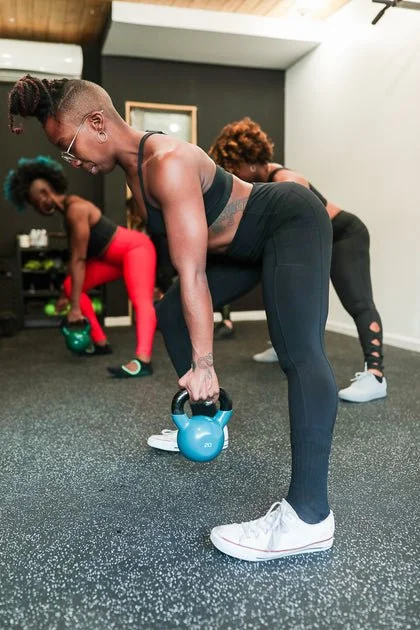
2 strength sessions, like Strong, Lift & Length or Stronger, with loads that feel challenging by the last few reps. New to lifting? Start with Strong: Fundamentals. Kettlebell work, squats, deadlift patterns, rows and presses are the foundation.
1–2 Pilates or mobility sessions for core strength, posture and balance.
Daily movement: walking, stairs and, yes, those subway steps count.
Progress over time. The thing that made the difference for Vicki (and in LIFTMOR) was gradually lifting more.
Black women and bone health
Black women are often told osteoporosis "isn't our problem." It's more complicated than that. The Bone Health & Osteoporosis Foundation estimates that 5% of African American women over 50 have osteoporosis and another 35% have low bone mass. The foundation also notes that lactose intolerance and low vitamin D, both common in Black communities, can make it harder to get the calcium bones need.
If you're a Black woman over 40, ask your doctor whether a bone density scan makes sense for you. Don't wait for a fracture to start the conversation.
FAQ
Can you rebuild bone density after menopause? Research like the LIFTMOR trial shows that supervised, progressive strength training can increase spine bone density in postmenopausal women with low bone mass. Results vary person to person, and many women combine training with medication their doctor prescribes.
How often should I strength train for bone density? The LIFTMOR participants trained twice a week for 30 minutes. Two to three strength sessions a week, with loads that challenge you, is a good goal for most women.
Is it safe to lift weights if I have osteopenia or osteoporosis? For many women, yes, with medical clearance and good coaching. In LIFTMOR, women with low bone mass lifted heavy safely under supervision. Start with an assessment, learn good form, and build up gradually.
Is Pilates good for bone density? Pilates builds core strength, balance and posture, which lower your fall risk. For bone density specifically, pair it with resistance training that adds load, and ask your instructor to modify spinal flexion if you have osteoporosis.
Start where Vicki started
Vicki's turnaround began with one assessment. Book a private training assessment and we'll build a strength plan around your goals, your bone health and your schedule. Or start with our InBody body composition scan to see your lean muscle mass, then take a strength class in Bed-Stuy, Crown Heights or East New York.
Related: My Journey With Early Menopause and Things You Should Know · InBody vs. the Scale
This article is for educational purposes and isn't medical advice. Talk to your doctor before starting a new exercise program, especially if you've been diagnosed with osteopenia or osteoporosis.
Sources
Watson SL, et al. High-Intensity Resistance and Impact Training Improves Bone Mineral Density and Physical Function in Postmenopausal Women With Osteopenia and Osteoporosis: The LIFTMOR Randomized Controlled Trial. Journal of Bone and Mineral Research, 2018. PubMed
Bone Health & Osteoporosis Foundation, What Women Need to Know